API Insights
REST vs GraphQL vs gRPC in 2025: How to Choose for Your API Portfolio
A practical decision framework for choosing REST, GraphQL, or gRPC in 2025—covering performance, schema governance, client ecosystems, and operations.
REST, GraphQL, and gRPC all have a place in modern API portfolios. The key is matching each protocol to the right audience, performance profile, and governance model. This decision guide draws on our work across Custom API Development, API Consulting & Strategy, and technology projects in REST, GraphQL, and FastAPI.
Short answer
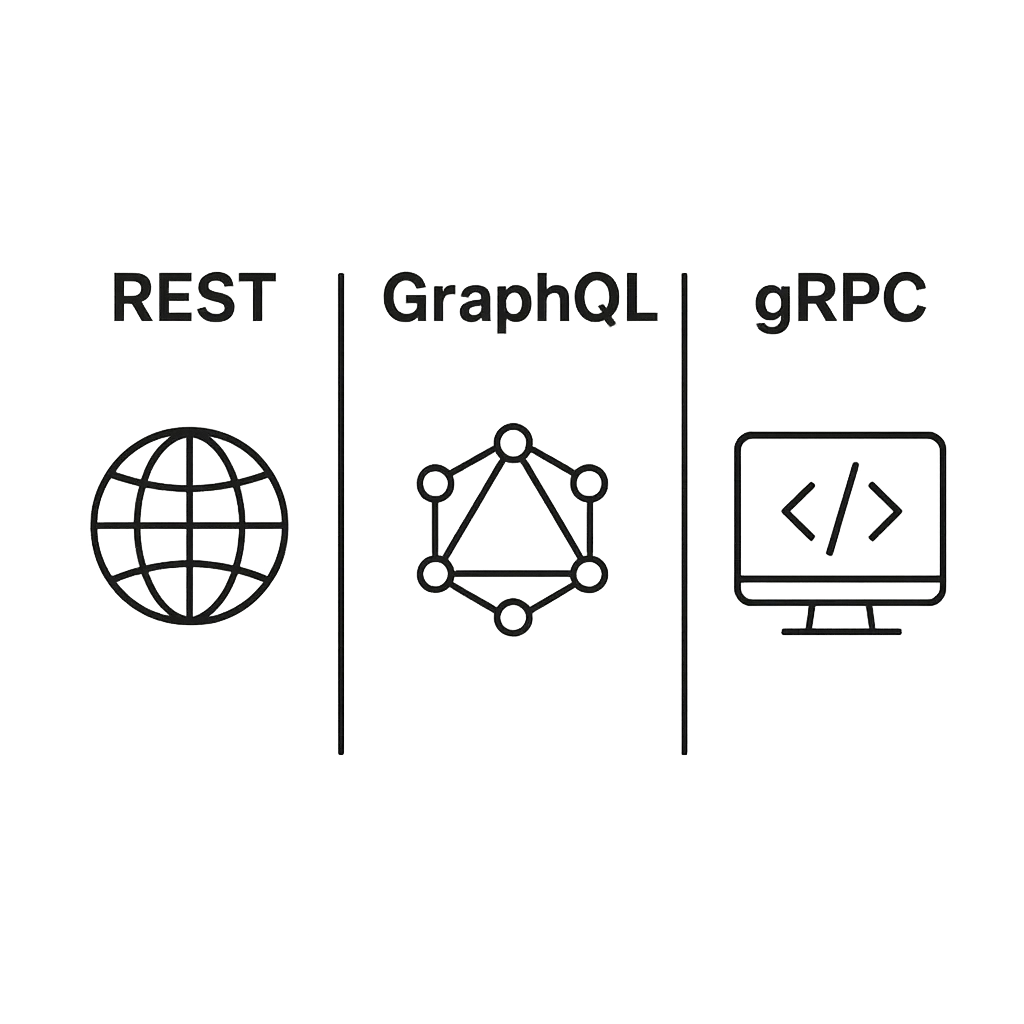
- REST delivers broad compatibility, straightforward caching, and predictable resource URLs—ideal for public or partner-facing APIs.
- GraphQL excels when multiple front-ends need flexible composition and want to eliminate over- or under-fetching.
- gRPC offers compact, fast, bidirectional streams—perfect for internal service-to-service communication when latency matters.
Decision factors
Client ecosystem & distribution
- REST remains the lowest-friction choice for third parties or partners with mixed stacks.
- GraphQL shines when mobile, web, and embedded teams want a single schema with typed queries.
- gRPC targets trusted, homogeneous environments (microservices, edge workers) where client libraries can be generated.
Caching & transport
- REST leverages HTTP caching (ETags, conditional requests) and CDN distribution naturally.
- GraphQL requires persisted queries or response caching at the gateway to avoid cache misses.
- gRPC relies on gateway-level caching or domain-specific memoization because responses stream over HTTP/2.
Schema governance & versioning
- REST pairs well with OpenAPI contracts and versioned routes.
- GraphQL favors schema deprecations and additive evolution; breaking changes should be coordinated via schema registries or gateway versioning.
- gRPC depends on Protocol Buffers with backward-compatible message evolution and strong CI checks.
Streaming & bidirectional needs
If you require true streaming (chat, telemetry, IoT), gRPC’s bidirectional channels win. GraphQL subscriptions can fill lightweight pub/sub needs, while REST typically delegates streaming to WebSockets or SSE.
Security & rate limits
- All protocols should adopt scoped tokens, rate budgets per consumer, and monitoring per tenant.
- Track OAuth 2.1 developments: implicit flows are deprecated, PKCE becomes the default, and refresh rotation becomes mandatory. Follow the OAuth 2.1 draft even though it is still in-flight.
- Align with the OWASP API Security Top 10 regardless of protocol.
Organizational skills & tooling
Choose the protocol your teams can support. Offer platform tooling—code generators, linting, schema registries, and observability dashboards—so teams move quickly without breaking compatibility.
Operational checklists
Operations checklist by protocol
- REST: Resource naming guidelines, optional HATEOAS, ETags, conditional requests, and backwards-compatible versioning strategies.
- GraphQL: Persisted queries, depth/complexity analysis, rate limiting, schema registry, and a federation plan if the graph grows.
- gRPC: Compatibility tests baked into CI, load-balancer timeouts tuned for streaming calls, OpenTelemetry spans, and fallback gateways for clients who cannot speak gRPC.
FAQ
Can I mix protocols?
Yes—many organizations expose REST for partners, rely on GraphQL as a composition layer, and connect internal services via gRPC.
How do I version GraphQL?
Favor additive changes and deprecations. For breaking changes, version the schema at the gateway or slice by graph (federation) rather than renaming the entire endpoint.
What about mobile clients on flaky networks?
Use persisted queries for GraphQL to shrink payloads, or gRPC for compact binary frames; both reduce chattiness compared to traditional REST.
Need help implementing this?
Email us the context and we'll align the approach with your systems, teams, and timelines.